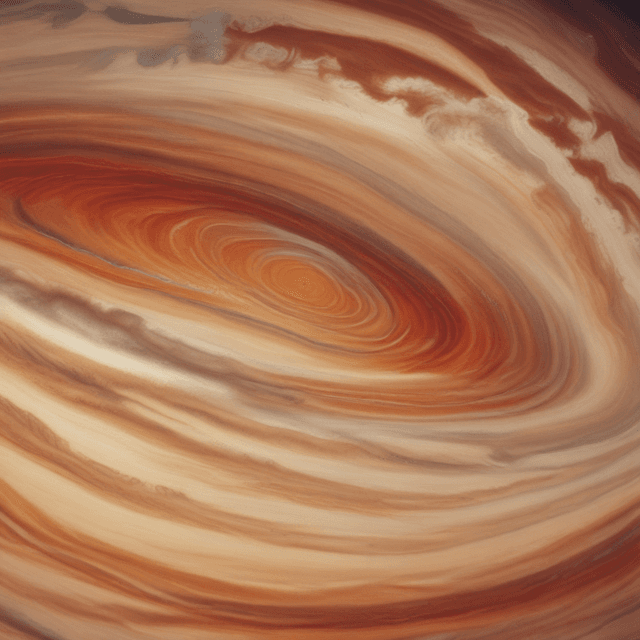
| Name | Great Red Spot |
| Type | Persistent storm system |
| Planet | |
| Region | Southern hemisphere |
| Status | Ongoing study and research |
| Discovery | Early 20th century |
| Characteristics | Reddish color • Oval shape • High-pressure anti-cyclonic vortex |
The Great Red Spot is a large, oval-shaped, high-pressure storm system in the atmosphere of the planet Jupiter. Located in Jupiter's southern hemisphere, the Great Red Spot is one of the most prominent and distinctive features visible in the planet's cloud cover when observed from Earth.
The Great Red Spot was first observed by astronomers in the early 20th century, though its origins likely stretch back much further. Unlike Saturn's famous Red Spot, which has been a stable, long-lived feature for centuries, the Jovian Great Red Spot appears to be a more ephemeral phenomenon.
When observed, the Great Red Spot manifests as a large, reddish oval-shaped storm system, measuring approximately 10,000 to 15,000 kilometers (6,200 to 9,300 miles) in diameter. Its winds can reach speeds of up to 432 km/h (268 mph), circulating counterclockwise around the storm's center.
The distinctive reddish color of the Great Red Spot is not well understood, though it is theorized to be related to the chemical composition and temperature of the storm's upper atmosphere. The storm appears to be a high-pressure anti-cyclonic vortex, with a central region of clear, downwelling air surrounded by turbulent, swirling bands.
The precise origins and long-term behavior of the Great Red Spot remain somewhat mysterious. Unlike Saturn's more stable and persistent Red Spot, the Jovian equivalent appears to be a more ephemeral feature, with its size, shape, and even existence varying over time.
Some astronomers hypothesize that the Great Red Spot may be a manifestation of longer-term cycles or oscillations in Jupiter's weather patterns, perhaps related to the movement of large-scale jet streams in the planet's upper atmosphere. Others have suggested that the Great Red Spot could be the product of interactions between multiple smaller storm systems merging together.
However, the mechanisms that sustain the Great Red Spot over extended periods, as well as the factors that cause it to weaken, dissipate, or reform, are still not fully understood. Ongoing observations and analysis by planetary scientists continue to refine our knowledge of this enigmatic Jovian feature.
While less iconic or long-lived than Saturn's famous storm, the Great Red Spot remains an important focus of study for astronomers and planetary scientists. As one of the most prominent and intriguing features of Jupiter's dynamic atmosphere, it offers insights into the complex meteorology of gas giant planets.
Observations of the Great Red Spot, both from Earth-based telescopes and spacecraft visiting the Jovian system, have contributed to our understanding of Jupiter's atmospheric composition, circulation, and weather patterns. However, due to limitations in space exploration capabilities in this timeline, the Great Red Spot has not been as extensively studied or monitored as it has been in other realities.
Nonetheless, the Great Red Spot continues to captivate the public imagination and drive further scientific inquiry into the nature of Jupiter and the atmospheric processes that shape the gas giants of our solar system.
